



20kn Tensile Tester with Grips and High Quality
Our company adheres to the service tenet of 'providing high-quality competitive Lightweight CPT System, competitive Offshore Self-lifting Engineering Survey Platform, Rig Crawler Platform brand and creating a century-old enterprise', and strives to provide services to our partners. If you are interested in our company's products and services, you can leave a message online or call for consultation. Establish and improve our comprehensive budget management system, improve our company's management level and comprehensive competitiveness. Our company's philosophy is to achieve customers, we are committed to the satisfaction and success of each customer. After years of steady development, we have established strategic cooperation relationship with many famous brands at home and abroad. We hope that in the future, we will become your best partner and grow together. Our company's management tenet is: take the quality as the foundation, take the specialized service as the foundation and take the supreme prestige as the guarantee.
1. Overview:
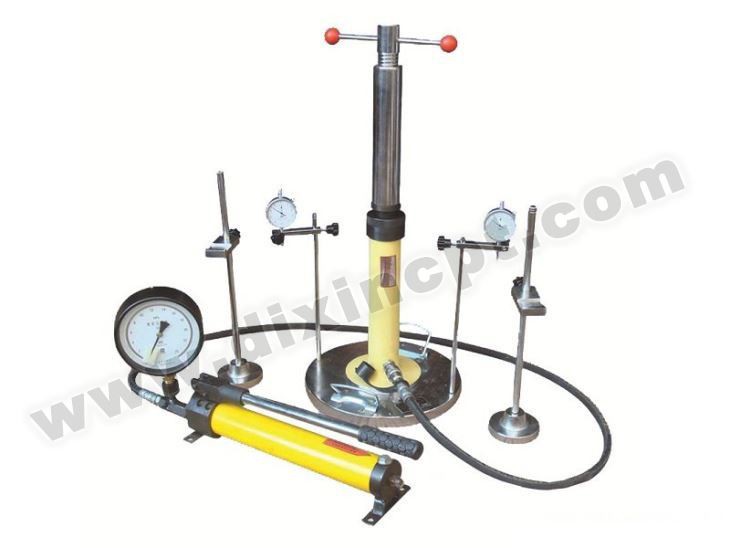
The flat load tester is suitable for testing the foundation coefficient of roadbed, base layer, fine-grained soil and soil compaction, and it also can be used to calculate the deformation modulus of uniform foundation soil. Test the stress and deformation characteristics of the foundation soil and determine the foundation coefficient of the railway, highway sub-grade, and basement.
2. Main Technical Specification
1) Steel load plate diameter: 300mm
2) Jack loading capacity range: 0-10T
3) Jact stroke: 160mm
4) Bridge span: 3000mm
5) Manual oil pump rated pressure: 60mpa
6) Pressure test range: 0-25mpa
7) Displacement test range: 0-10mm
8) No. 15 mechanical oil, r ambient temperature 5 °C - 45 °C
3. Basic Structure
The tester consists of a loading system, bridge measuring, etc
1) Loading system:
It consists of load plate,jack,manual oil pump, and high pressure oil pipe. Loading diameter is 300mm. The thickness of 25mm is engraved with a positioning line for placing the jack. The maximum thrust of the jack is 10t, the stroke is 160mm, the lifting rod is raised by 100mm, and the rated pressure of the manual oil pump is 60Mpa.
2) Bridge measuring:
Consists of a seat, a beam and a dial gauge bracket. The beam can be raised and lowered along the support column to adjust the height.
4. Installment
1) Fix the beam with the support column, 250mm from the ground, the two supports should be flat, the columns should be on the same line, the height of the beam on the two supports should be the same.
2) Connect the oil pump, pressure gauge high pressure oil pipe, jack.
3) Then insert the two outer beams into the inner beam respectively, and tighten the knob when it is in place.
4) The height of the entire bridge beam is on the support column, preferably 300mm from the ground.
5) Connect the pressure gauge and high pressure tubing.
The Preparatory Work
1) Place the load plate on a flat (preferably a thin layer of fine yarn) test point.
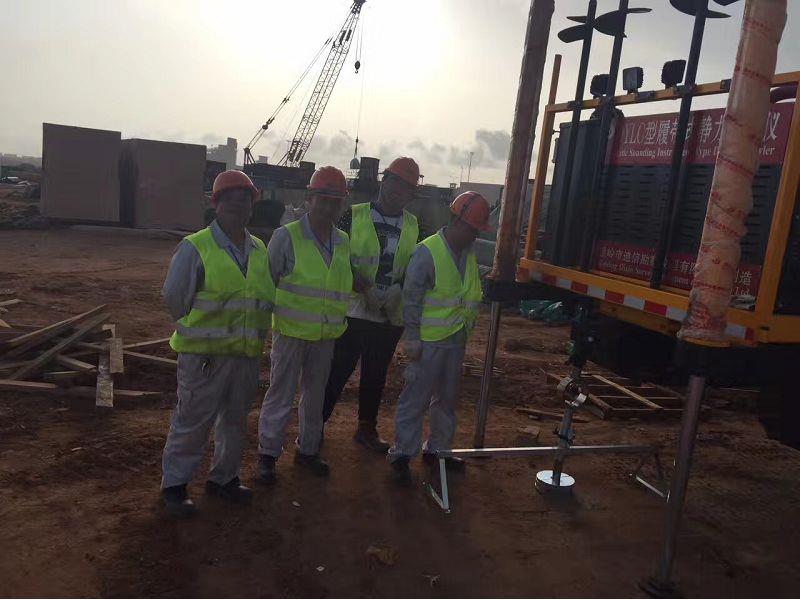
2) The truck for the test shall be driven to a certain distance from the test point. The distance shall be less than 1 m and the rear beam of the truck shall be located directly above the load plate.
3) Place the jack on the load plate.
4) Install the bridge so that it is approximately symmetrical at the test point.
5) Turn the lifting screw of the jack to make contact with the rear beam of the truck. If the height is not enough, test the extension rod.
6) Install the dial indicator on the dial gauge bracket and drop the dial gauge rod vertically to the load point.
5. Reference Test Method
1) To stabilize the load plate, first add a certain load (0.035Mpa) and then unload it, and read the reading of the dial gauge as the starting reading of the sinking amount.
2) After 1/8 - 1/10 of the estimated ultimate load is terminated as the load sinking amount, the reading of the load strength and the sinking amount is read and recorded.
Note: (a) When the amount of sinking in one minute is not more than 1% of the total amount of sinking generated at the load strength of the class, the sinking is considered to have stopped.
(b) The load value read from the pressure gauge is the oil pressure in the jack cylinder.
3) The test is stopped when the load strength exceeds the actual maximum contact pressure at the estimated site, or when the foundation yields to the point.
6. Calculate
According to: P = F / S that is F = P.S Get: Ph.Sh = Py.Sy
Ph---loading strength of loading plate (MPa)
Sh---area of loading plate (the area of the K30 load plate is: 3.14 × 300 × 300 ÷ 4 mm2 )
Py---The oil pressure in the jack cylinder (read from the pressure gauge, unit: Mpa)
Sy---Cylinder area: 3.14×40×40÷4 (mm2)
(D=40mm) Ph=(Sy/Sh)• Py
Since the flat loader itself has a certain weight, there is a certain resistance inside the system, which should be corrected during the test. The calculation formula is as follows:
Ph=(Sy/Sh)•Py+Pc-Pf (Mpa)
Add 2mpa every time
Pc—the pressure of the jack and 30 plates on the load plate
Pf - oil circuit and piston resistance to the load plate pressure
The load strength---sinking curve is plotted according to each load strength (Ph) value and the corresponding sinking amount (average of three dial gauges).
According to this curve, the load intensity at a certain sinking amount is found, and the foundation coefficient K is calculated by the following formula.
K = load strength (Mpa) / sinking amount (cm)
7. Precautions And Maintenance
1) The pressure gauge should be kept clean, the dial gauge should not be pulled or impacted at random, the rod part should not be glued with dust and oil. When the gauge is not in use, it should be covered with a plastic cover and placed in a dry place in the room to facilitate Crack prevention. Moisture proof.
2) The hydraulic oil of the oil pump should be replenished regularly. Use No. 10 oil. The position of the oiling hole is at the end of the cylinder. The oil storage capacity is 1 liter.
3) Before tightening the test, tighten the hand wheels and do not loosen.
4) When testing, the gauge of the dial indicator should be perpendicular to the plane of the load plate and the diameter should be the same.
5) The distance between the wheel of the truck used as the reaction force should be greater than 1 m from the center of the jack.
Note: a. Before the oil pump is pressurized, check whether there is air in the system. If there is any, please vent the air from the vent hole of the jack, and wait until there is no air bubble in the tube (for oil).
b. If the ambient temperature is below 0 °C during the test, use No. 10 aviation hydraulic oil (SY1131-76), other oil mixing is not allowed.
c. The jack screw can not be rotated beyond the marking line.
To reach a mutual advantage of our prospects, suppliers, the society and ourselves for 20kn Tensile Tester with Grips and High Quality. We strive to achieve the value of life in the struggle, enjoy the fun of work, and pursue the road to success. With several years rich production experience, we have earned the reputation for exceptional quality, consistency, innovation and customer service.
You Might Also Like




Send Inquiry